
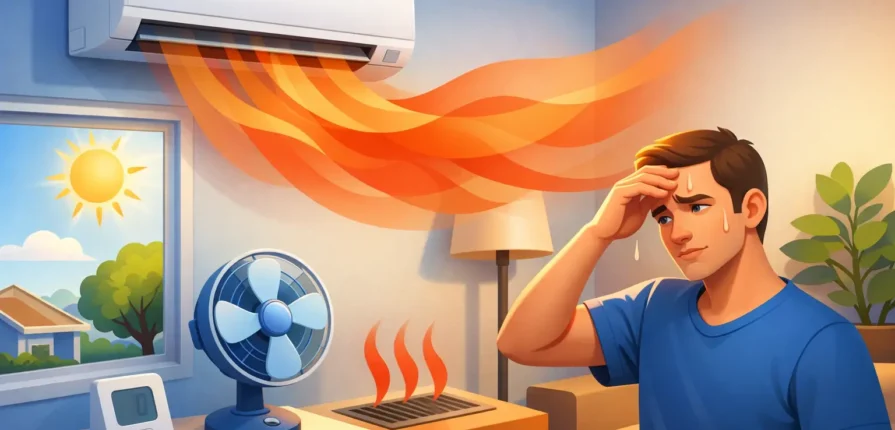
You set the thermostat, wait for the house to cool down, and instead your vents start pushing out warm air. If you’re asking, “why is my ac blowing warm air,” you’re usually dealing with one of a handful of common problems – and some are simple while others need a technician fast.
The first thing to know is that warm air from your AC does not always mean the whole system has failed. Sometimes it’s a thermostat setting, a dirty filter, or a tripped breaker. Other times, it points to low refrigerant, a frozen evaporator coil, or a failing outdoor unit. The difference matters, especially during a hot Ohio summer when a small issue can turn into a full breakdown.
Why is my AC blowing warm air when the system is running?
Air conditioning systems cool your home by moving heat out, not by “making cold.” That means your indoor and outdoor equipment both have to do their jobs. If one part stops working properly, you may still feel air coming through the vents, but it won’t be cool.
That is why this problem can be confusing for homeowners. The fan may run, the thermostat may light up, and the system may sound normal at first. But if the condenser outside is not running, if airflow is restricted, or if refrigerant levels are off, the air inside can come out lukewarm or flat-out warm.
Start with the simple checks first
Before assuming you need a major repair, check the thermostat. Make sure it is set to “cool” and not “fan” or “heat.” A surprising number of service calls come down to incorrect settings, especially after a power outage, battery change, or someone adjusting the controls without realizing it.
Next, look at the temperature setting itself. If the thermostat is set higher than the room temperature, the AC will not actually cool. If you have a programmable or smart thermostat, review the schedule too. Sometimes the issue is not the equipment but the programmed settings changing the system’s behavior.
Then check the air filter. A clogged filter restricts airflow and can cause the system to struggle, overheat, or freeze up. If the filter looks gray, dusty, or packed with debris, replace it. This is one of the easiest and most affordable fixes, and it can make a real difference.
You should also check the breaker panel. Your indoor unit and outdoor unit may be on separate breakers. If the indoor blower is running but the outdoor condenser has lost power, you’ll get airflow without cooling. If a breaker is tripped once, reset it carefully. If it trips again, stop there and have it checked professionally.
Common reasons your AC is blowing warm air
One of the most common causes is a dirty or blocked condenser unit outside. Your outdoor system needs open airflow to release heat. If the unit is buried in cottonwood, grass clippings, leaves, or general debris, it cannot get rid of heat effectively. The result can be poor cooling or warm air inside.
Low refrigerant is another frequent problem. Refrigerant does not get “used up” like fuel. If your system is low, that usually means there is a leak. You may notice weak cooling, longer run times, ice on the lines, or hissing sounds. Adding refrigerant without finding the leak is usually a temporary fix, not a real repair.
A frozen evaporator coil can also cause warm air. That sounds backward, but when the indoor coil freezes, airflow drops and cooling performance falls apart. The ice may result from a dirty filter, blocked airflow, low refrigerant, or a blower problem. If you see ice on the refrigerant line or indoor unit, shut the system off and let it thaw before service.
Capacitor and contactor problems are also common in summer. These parts help your outdoor unit start and run properly. When they fail, the condenser may not kick on even though the indoor fan keeps moving air. That often leads homeowners to say, “My AC is on, but it’s not cooling.”
In some cases, the issue is the compressor. This is one of the more serious possibilities because the compressor is central to the cooling process. A failing compressor can cause reduced cooling, loud noises, warm air, or complete system shutdown. Depending on the age of the equipment, repair versus replacement becomes a real conversation.
Why is my AC blowing warm air after it worked fine yesterday?
Sudden changes usually point to an electrical issue, a failed component, or an airflow problem that finally caught up with the system. Capacitors can fail without much warning. A clogged filter can slowly strain the system until cooling performance drops off. Breakers can trip during heavy heat when equipment is working harder than usual.
Ohio weather also plays a role. During a stretch of high heat and humidity, an older AC system has to work longer cycles. If it already has worn parts or poor maintenance history, that extra load can expose problems fast. What seemed like a small performance issue last week can turn into warm air this week.
If your AC was cooling normally and now suddenly is not, pay attention to what changed. Was there a storm, a power flicker, a thermostat battery swap, or yard work around the outdoor unit? Those details can help narrow down the problem.
When warm air points to a repair call
There is a point where DIY checks should stop. If the breaker keeps tripping, the copper line is frozen, the outdoor unit will not start, or the system is making buzzing or humming sounds without cooling, it is time for service. The same goes for refrigerant issues. Handling refrigerant is not a homeowner job, and guessing at the cause can make the repair more expensive.
Age matters too. If your system is 12 to 15 years old and starts blowing warm air repeatedly, the problem may be bigger than a one-time part replacement. That does not always mean replacement is the only answer, but it does mean you want an honest diagnosis from an experienced HVAC technician.
Property managers and business owners should be especially careful not to delay. A comfort issue in a rental, office, or small commercial space can escalate quickly into tenant complaints, productivity problems, or after-hours emergency calls. Fast diagnostics usually save money compared with waiting for a total shutdown.
What a technician will usually check
A proper AC diagnosis should go beyond just topping off refrigerant or replacing a single part without testing the system. A technician should inspect thermostat operation, filter condition, system pressures, electrical components, condensate drainage, blower performance, and condenser operation. The goal is to fix the cause, not just the symptom.
This matters because warm air can have more than one cause at the same time. A dirty filter and a weak capacitor can exist together. Low refrigerant may have already damaged compressor performance. A good service call looks at the full picture so you are not paying for repeat visits a week later.
For homeowners in Delaware, Powell, Lewis Center, Marysville, Marion, Mansfield, Sunbury, Galena, Westerville, Columbus, and nearby communities, fast local service matters when heat builds up indoors. Professional Trade Service handles these calls with the kind of direct, practical approach people expect – find the problem, explain it clearly, and get the cooling back on.
How to lower the chances of warm air problems
Regular maintenance is still the best prevention. Seasonal tune-ups help catch weak capacitors, dirty coils, airflow restrictions, and refrigerant issues before they turn into emergency repairs. It is usually cheaper to clean, test, and adjust a working system than to deal with a breakdown during the hottest week of the year.
Homeowners can help by changing filters on schedule, keeping the outdoor unit clear, and paying attention to early warning signs. If rooms start feeling uneven, if energy bills jump, or if the AC runs longer than usual without keeping up, do not ignore it. Those are often the signs that something is starting to slip.
It also helps to be realistic about system age and condition. Older equipment can still run well if maintained, but it will not have the same margin for error as a newer system. If your AC has needed frequent repairs, a straight answer about repair costs versus replacement may be the most cost-effective path.
Warm air from your vents is frustrating, but it is usually not random. The system is telling you something is off, and the sooner you catch it, the better your chances of a simpler fix, a lower repair bill, and a cooler house by the end of the day.
Recent Comments