
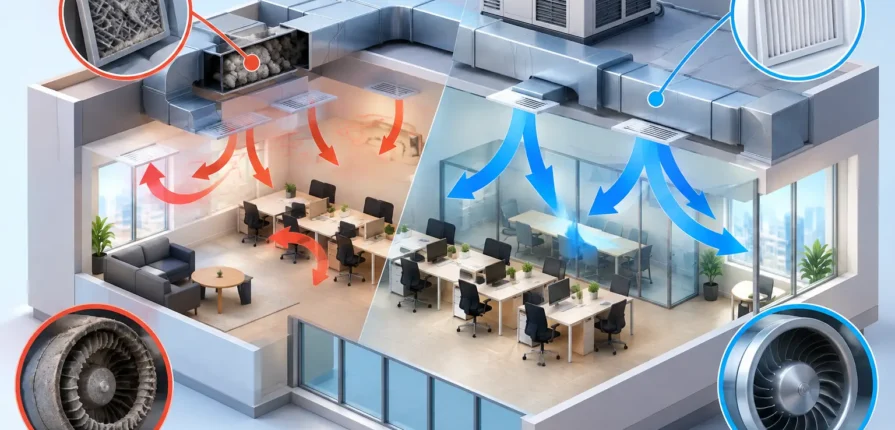
A conference room that stays stuffy while the lobby feels like a refrigerator is not just an annoyance. Commercial airflow problems can drive up utility bills, lead to tenant complaints, make employees uncomfortable, and put unnecessary strain on heating and cooling equipment. In a restaurant, office, retail store, or multi-unit property, uneven air delivery is often an early warning that the HVAC system needs attention.
The right fix depends on what is restricting or misdirecting the air. Sometimes the answer is as straightforward as replacing neglected filters. Other times, the problem is in the ductwork, controls, equipment sizing, or ventilation design. Finding the real cause matters because simply turning down the thermostat will not correct poor airflow.
What Commercial Airflow Problems Look Like
Airflow trouble does not always mean the system has stopped working. In fact, many businesses continue running their HVAC equipment while comfort and operating costs quietly get worse.
Common signs include hot and cold spots between rooms, weak air coming from supply vents, rooms that take too long to heat or cool, and a thermostat that seems unable to hold the setting. You may also hear whistling at vents, banging in ductwork, or unusual noise from the blower. In more serious cases, equipment may run nearly nonstop, freeze up in cooling season, or shut down on a safety control.
For property managers, complaints from only one suite or one area of a building can be easy to dismiss. But localized discomfort often points to a damper issue, blocked diffuser, duct leak, or a zone control problem. Addressing it early can prevent a smaller airflow issue from becoming a costly repair or premature equipment replacement.
The Most Common Causes of Poor Airflow
Dirty filters and blocked coils
A clogged air filter is one of the simplest and most common causes of restricted airflow. Filters collect dust, construction debris, pet hair, and other airborne material. Once they load up, the blower has to work harder to pull air through the system.
Dirty evaporator coils can create a similar restriction. If the cooling coil is coated in dirt, it limits both airflow and heat transfer. The building may feel humid or warm even though the air conditioner is running. In heating systems, dirty components can also reduce performance and contribute to overheating issues.
Filter changes are basic maintenance, but commercial buildings often use different filter sizes and replacement schedules than homes. A busy retail space, shop, or property near construction may need more frequent service than a lightly used office.
Duct leaks, damage, and poor design
Ductwork is responsible for moving conditioned air where it needs to go. If ducts are disconnected, crushed, leaking, or poorly insulated, a substantial amount of that air may never reach the occupied space. Leaks above ceilings, in mechanical rooms, or in unconditioned areas waste energy while forcing the system to run longer.
Duct design also matters. A building addition, remodeled office, or repurposed retail space may have more load than the original duct system was designed to handle. Adding a few vents does not always solve the problem. The blower, duct sizing, return-air path, and balancing all need to work together.
Closed dampers, blocked returns, and vent obstructions
Supply registers and return grilles need open paths. Furniture, inventory displays, file cabinets, ceiling tiles, and even stacked boxes can block air movement. Closing supply vents in unused rooms may seem like a way to save money, but it can increase pressure in the duct system and reduce airflow elsewhere.
Manual balancing dampers can also be moved accidentally during maintenance or renovation work. If one zone suddenly becomes uncomfortable after work was done above a ceiling or near ductwork, a damper check is a sensible first step.
Return-air problems are just as important. Your system cannot supply air effectively if it cannot pull enough air back. Undersized or blocked return openings can cause noisy airflow, pressure differences between rooms, and weak performance throughout the building.
Blower, belt, and motor issues
The blower assembly is the part of the HVAC system that actually moves the air. Worn belts, failing motors, damaged blower wheels, loose electrical connections, and incorrect speed settings can all reduce circulation.
These issues are not always obvious from the occupied areas of the building. A technician may need to inspect the equipment, measure static pressure, check motor amperage, and verify blower operation. Continuing to run a system with an airflow restriction can cause the blower and other components to wear out faster.
Thermostat and zoning control failures
In many commercial spaces, one thermostat cannot accurately represent the comfort needs of the whole building. Sun exposure, exterior doors, kitchen equipment, server rooms, occupancy, and business hours all affect individual areas differently.
Zoned systems use thermostats, dampers, and controls to direct heating and cooling where it is needed. When those controls fail, one part of the building may receive too much air while another gets too little. A thermostat may be reading the wrong temperature, a damper may be stuck, or the control schedule may not match current operating hours.
Equipment that is the wrong size
An oversized unit can cool or heat a space quickly without properly distributing air or managing humidity. An undersized unit may run constantly and still fall behind during Ohio’s hottest or coldest weather. Neither situation is good for comfort or long-term operating cost.
Sizing is not based on square footage alone. A professional evaluation should consider insulation, windows, ceiling height, occupancy, equipment loads, ventilation requirements, and the condition of the existing duct system. This is especially important before replacing an aging rooftop unit, furnace, or split system.
Why Ignoring Airflow Issues Costs More
Poor airflow is hard on HVAC equipment. Restricted air across an air conditioner coil can lead to freezing and compressor damage. Low airflow across a furnace heat exchanger can cause overheating and repeated limit switch trips. Constant cycling or long run times add wear, raise energy use, and shorten the useful life of the system.
There is also a business cost. Employees work better in a comfortable space. Customers are less likely to linger in a store or restaurant that feels too hot, too cold, or overly humid. For landlords and property managers, unresolved comfort complaints can quickly turn into recurring calls and unhappy tenants.
How a Professional Diagnoses Commercial Airflow Problems
A proper airflow diagnosis should go beyond checking the thermostat and changing a filter. An experienced HVAC technician starts by listening to what occupants are noticing and identifying which areas are affected. That helps determine whether the problem is system-wide or limited to a particular zone.
From there, the inspection may include checking filters, coils, belts, blower operation, refrigerant-related symptoms, dampers, returns, supply registers, and duct connections. Static pressure testing and airflow measurements can show where the restriction is occurring. Controls and schedules should also be reviewed, especially if the issue happens only at certain times of day.
This approach prevents guesswork. Replacing a thermostat will not fix a collapsed duct. Adding refrigerant will not solve a plugged filter or weak blower. A clear diagnosis gives you a practical repair recommendation and helps you decide whether repair, duct modification, balancing, or equipment replacement makes the most financial sense.
Preventing Airflow Trouble Before It Starts
Regular maintenance is the best defense against avoidable airflow problems. Filters need to be checked on schedule, but maintenance should also include inspection of blower components, electrical connections, drains, coils, belts, ductwork, and safety controls. Seasonal service gives technicians a chance to catch restrictions before peak heating or cooling demand exposes them.
Building changes deserve attention, too. If you add equipment, rearrange a workspace, close off rooms, expand into another suite, or change how a space is used, the HVAC system may need to be adjusted. What worked for a quiet office may not work for a busy training room, salon, kitchen, or retail floor.
For businesses and property managers in central Ohio, Professional Trade Service can inspect the system, identify the source of uneven airflow, and make repairs without wasting time on temporary fixes. If comfort complaints are growing or equipment is running harder than it should, schedule service before the next weather extreme turns a manageable issue into an urgent call.
Recent Comments