
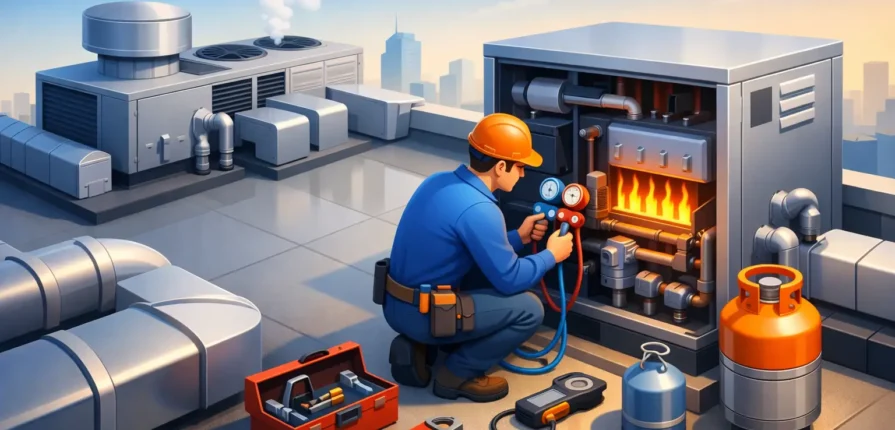
A failed rooftop unit at 6 a.m. can turn into tenant complaints, staff discomfort, and lost business before the day even gets started. That is why commercial heating repair Ohio property owners and managers rely on needs to be fast, accurate, and built around keeping the building operating – not just getting the heat back on for the moment.
Commercial systems usually give some warning before they quit completely. The trouble is that those warning signs are easy to ignore when the building is still mostly comfortable. A little extra noise, uneven heat in a back office, longer run times, or a utility bill that suddenly climbs can all point to a heating system that is working harder than it should. Waiting often turns a manageable repair into a full shutdown at the worst time.
When commercial heating repair in Ohio becomes urgent
Ohio winters do not leave much room for guesswork. In a commercial building, heat problems affect more than comfort. They can disrupt employees, customers, equipment, inventory, and daily operations. For some spaces, including offices, retail stores, churches, light industrial buildings, and mixed-use properties, loss of heat can create safety and liability concerns fast.
Urgent repair usually means one of two things. Either the system has stopped producing heat, or it is still running but doing it poorly enough that the building cannot maintain safe, usable temperatures. Short cycling, burner problems, ignition failure, airflow restrictions, tripped safety controls, failing blower motors, cracked heat exchangers, and thermostat communication issues can all be part of the problem. On larger systems, one bad component can also put added strain on the rest of the equipment.
The hard part is that symptoms do not always point to one simple cause. Cold spots could come from duct leakage, a weak blower, a control issue, or a unit that is undersized for the load. High gas usage could mean dirty burners, poor combustion, or a system that has been compensating for another hidden problem for weeks. That is why real diagnostics matter.
Common signs your commercial heating system needs repair
A complete breakdown gets attention right away. Smaller performance issues are where money gets wasted. If your building manager or maintenance staff is seeing recurring comfort complaints, there is usually a reason.
Uneven temperatures are one of the biggest red flags. If one suite is too warm while another stays cold, the issue may involve zoning, airflow, controls, or equipment performance. Strange noises matter too. Banging, rattling, whining, or repeated startup attempts are not normal operating sounds.
Another sign is rising energy cost without a clear change in occupancy or weather. Commercial heating equipment loses efficiency as parts wear, filters clog, burners get dirty, or controls drift out of calibration. You may still have heat, but you are paying more to get less of it.
Frequent resets are another warning. If staff has to cycle the unit or reset the thermostat to get heat back, the system is not fixed. It is failing in a way that has not been diagnosed yet. That usually leads to a no-heat call later.
Poor indoor air quality can also be tied to heating trouble. Dust buildup, stale air, unusual odors, or dry, uncomfortable indoor conditions may point to airflow issues, dirty components, or ventilation problems happening alongside the heating failure.
Why fast diagnosis matters more than a fast guess
In commercial service, speed matters, but speed without proper testing can cost you twice. Swapping parts based on a hunch may get the system running for a day or two, but it does not solve the reason the part failed in the first place.
A good commercial heating repair call should answer a few basic questions. What failed? Why did it fail? Did that failure affect other components? Is this a one-time repair, or is the system showing signs that larger work is close behind?
That last question is where honesty matters. Sometimes a repair is clearly the right move. If a unit is structurally sound and the problem is isolated, repair is the practical choice. Other times, the unit may be old, parts may be hard to source, or repeated failures may be telling you the equipment is reaching the end of its useful life. A dependable contractor should be able to explain that plainly, without pushing replacement when a repair still makes sense.
Commercial heating repair Ohio owners should plan before winter
The busiest heating calls of the year come when temperatures drop hard and systems that have been limping along finally give up. Planning ahead does not mean replacing equipment you do not need to replace. It means checking your systems before peak demand exposes every weak point.
Preventive service helps catch worn belts, failing ignitors, dirty burners, blocked drains, weak electrical connections, cracked hoses, and control issues before they shut the building down. It also gives you a better idea of which units are stable and which ones may need budget planning.
For property managers, that planning matters. A single building may have multiple package units, split systems, make-up air equipment, or older furnaces serving different spaces. Not every unit will age the same way. One may need a simple repair, while another is becoming a recurring expense. Looking at the whole property helps you make better decisions than treating every no-heat call as a surprise.
Repair or replace? It depends on the equipment and the risk
This is where a lot of commercial customers want a straight answer, and the truth is that it depends. Age matters, but age alone should not decide it. A well-maintained system can sometimes justify repair longer than a neglected one that is younger.
If the repair is minor and the unit has been reliable, fixing it is usually the sensible path. If the system is older, inefficient, and breaking down during high-demand periods, replacement may save more in downtime and repeated service than another patch job would. The availability of parts is a factor too. Some older commercial equipment becomes expensive to support simply because parts are delayed or discontinued.
Business use also changes the math. A small office with short operating hours may tolerate an older unit better than a restaurant, daycare, or retail site that needs dependable heat all day. The cost of one failure is not just the invoice. It can include disrupted business, upset occupants, and emergency service after hours.
What to expect from a reliable commercial repair visit
A solid service call should feel organized from the start. You want clear communication, arrival when promised, and a technician who understands commercial equipment instead of treating it like a residential furnace in a bigger box.
That means checking controls, electrical components, safeties, burners, heat exchangers where accessible, motors, belts, filters, airflow, venting, and thermostat operation. It also means explaining findings in plain language. If there are multiple issues, you should know which one caused the outage, which ones are contributing factors, and what needs immediate attention versus what can be scheduled.
For many local businesses and property owners, there is real value in working with one company that can also handle related electrical or plumbing issues when they affect building operation. A heating problem sometimes overlaps with power supply, drains, controls, or other building systems. Having one dependable call can save time when conditions are already stressful.
Professional Trade Service has built its reputation around that kind of practical support – straightforward service, experienced technicians, and help when the problem cannot wait until next week.
Choosing commercial heating repair in Ohio without getting burned
Price matters, but the cheapest repair is not always the least expensive outcome. If a contractor does not properly diagnose the issue, does not communicate clearly, or does not understand the equipment in your building, the same problem can come right back.
Look for experience with commercial service, not just home HVAC. Ask whether the company offers emergency response, whether they explain repair options clearly, and whether they can support ongoing maintenance after the immediate problem is fixed. Consistency matters more than flashy promises.
A good contractor should also respect your building schedule. Some repairs need to happen right away. Others can be staged around tenants, employees, or business hours. That flexibility can make a big difference in occupied spaces.
If your system has been making noise, heating unevenly, running longer than normal, or driving up utility costs, now is the time to address it. Waiting for a full breakdown rarely saves money. It usually just limits your options when you need heat the most.
The best time to deal with a commercial heating problem is when it is still small enough to control.
Recent Comments