
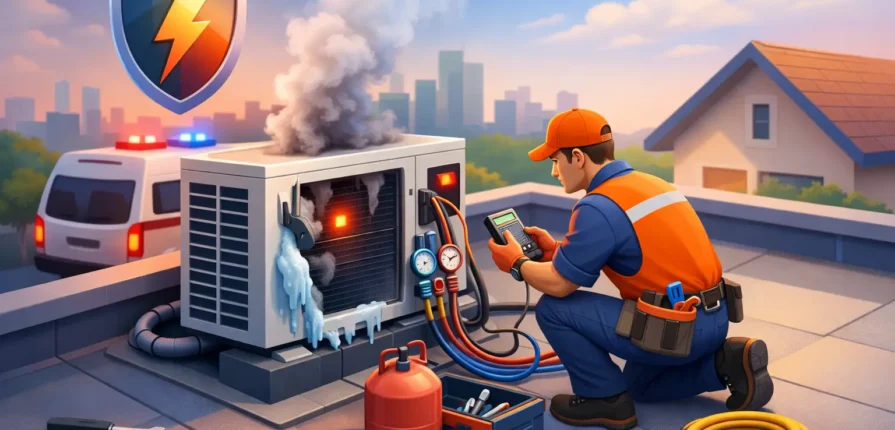
When your AC quits on a hot Ohio afternoon, the problem gets serious fast. This guide to emergency AC repair is built for homeowners and property managers who need clear answers, quick checks, and a smart next step without wasting time.
What counts as an AC emergency?
Not every air conditioning problem is a true emergency, but some situations need immediate attention. If your system stops cooling during extreme heat, that can become a health and safety issue for kids, older adults, and anyone with medical concerns. The same goes for a commercial space where indoor temperatures can affect employees, customers, inventory, or equipment.
An emergency also includes anything that suggests electrical risk, burning smells, smoke, buzzing from the panel, or water leaking where it should not. If your AC is short cycling, tripping breakers, or making a loud grinding or screeching sound, shutting it down and getting professional help is the safer move. Waiting can turn a repairable issue into compressor damage, water damage, or a much bigger bill.
On the other hand, weak airflow or a system that is cooling poorly but still running may feel urgent without being dangerous. That still deserves fast service, especially in the middle of summer, but the first step is a few basic checks.
Your first steps in an emergency AC repair situation
Before you assume the whole system has failed, take a calm look at the simple things. Start with the thermostat. Make sure it is set to cool, the temperature is set below the room temperature, and the batteries are not dead if your model uses them.
Next, check the air filter. A heavily clogged filter can choke airflow, cause the evaporator coil to freeze, and make the system stop cooling the way it should. If the filter is packed with dust, replace it. Then give the system some time to recover.
Go to your electrical panel and see if the breaker has tripped. If it has tripped once, you can reset it one time. If it trips again, stop there. Repeated breaker trips usually point to an electrical or mechanical problem that should not be handled as a DIY fix.
Look at the outdoor unit too. If the disconnect is off, if debris is packed around the condenser, or if the unit is coated with cottonwood, grass, or dirt, airflow may be blocked. Clear away loose debris around the unit, but do not open electrical panels or start taking equipment apart.
If you see ice on the refrigerant lines or indoor coil, turn the system off and switch the fan to ON if your thermostat allows it. Ice often means restricted airflow, low refrigerant, or another deeper issue. Running it while frozen can make things worse.
When to turn the system off immediately
Some problems call for immediate shutdown. If you smell something burning, hear metal-on-metal noise, see water leaking near electrical components, or notice sparking, turn off the unit at the thermostat and breaker. The same advice applies if the outdoor unit hums but does not start, or if the compressor tries to kick on and fails repeatedly.
This is where a good guide to emergency AC repair has to be honest – fast action matters, but guessing can cost you. Air conditioning systems combine refrigerant, electricity, motors, capacitors, drains, and control boards. A wrong move can damage expensive parts or create a safety issue.
Problems that often cause emergency AC breakdowns
In the field, a few problems show up again and again during summer emergency calls. Capacitor failure is common, especially during heavy heat. The system may hum, struggle to start, or stop running altogether. A bad contactor, failed blower motor, damaged condenser fan motor, or thermostat fault can show up the same way from the homeowner’s point of view – the house is hot and the system is not doing its job.
Low refrigerant is another frequent issue, but it is usually a sign of a leak rather than something that just ran out. If a system is low, it needs proper diagnosis, leak testing, and the right repair before charging. Simply topping it off without finding the cause is often a short-term patch.
Drain line clogs are also common, especially in humid weather. If the condensate drain backs up, some systems shut down on a float switch to prevent water damage. That protection is helpful, but the symptom feels like a sudden breakdown.
For older equipment, compressor problems become a bigger risk. If the compressor fails, repair costs may push you into replacement territory. That does not mean every major repair should become a full system replacement. It depends on the age of the unit, repair history, efficiency level, warranty status, and the condition of the rest of the system.
What you can do safely while waiting for service
If the system is off and you are waiting on a technician, focus on protecting people and preventing further damage. Close blinds on sunny windows, avoid using the oven, and use ceiling fans to move air. If you have a basement, spend more time there since it is often cooler. For businesses or rental properties, communicate early with tenants or staff so people can plan.
If there is active water around the indoor equipment, place towels or a pan where it helps and keep the area clear. If the leak is substantial, especially near finished ceilings or electrical components, that raises the urgency.
Do not keep trying to restart the equipment every few minutes. Repeated cycling can add stress to motors and compressors. One restart after your basic checks is reasonable. After that, let the technician diagnose it properly.
What to expect from a professional emergency AC repair call
A real emergency service visit should start with diagnosis, not guesswork. The technician should check electrical components, controls, refrigerant performance, airflow, drain operation, and the condition of major parts. You should get a clear explanation of what failed, what needs to happen next, and whether the repair makes sense.
This is also where experience matters. Emergency calls are not just about speed. They are about getting the problem right the first time. A rushed or sloppy diagnosis can lead to repeat failures, unnecessary parts, or money spent in the wrong place.
For homeowners and property managers, flat-rate pricing and plain talk matter too. You should know what you are approving. If there are multiple repair paths, a good contractor will explain the trade-offs. A lower-cost repair may get you through the season on an older system, while a more complete repair or replacement may be the better long-term move.
How to decide between repair and replacement
In an emergency, people often feel pressured to make a big decision fast. That is understandable, but it helps to look at a few basics. If the unit is newer and the repair is straightforward, fixing it is usually the practical choice. If the system is older, uses outdated refrigerant, breaks down often, or needs a major compressor repair, replacement may be the smarter investment.
Budget matters, of course. So does timing. Sometimes the right move is a repair that restores cooling now, followed by a planned replacement later when you have time to compare options. Sometimes that is not realistic, especially if the equipment is failing on several fronts.
An honest contractor should be able to tell you both sides without pushing. That kind of straightforward advice is one reason local customers call companies like Professional Trade Service when the temperature spikes and time matters.
How to reduce the odds of another emergency
Most emergency AC failures do not come out of nowhere. Dirty filters, weak electrical components, restricted drains, low refrigerant from a small leak, and worn motors usually leave signs before the full breakdown happens. The trouble is that those signs are easy to ignore until the hottest week of the year.
Seasonal maintenance gives you a better shot at catching those problems early. A tune-up can identify weak capacitors, dirty coils, poor airflow, loose electrical connections, and drain issues before they become after-hours calls. It also helps the system run more efficiently, which matters when utility bills are already climbing.
For property managers and busy homeowners, maintenance is less about perfection and more about risk reduction. You may not avoid every breakdown, but you can avoid many of the preventable ones.
A practical guide to emergency AC repair starts with the right call
If your AC has stopped working in severe heat, if it is making alarming noises, tripping breakers, leaking heavily, or showing signs of electrical trouble, it is time to stop troubleshooting and get professional help. Quick action can protect your comfort, your equipment, and in some cases your safety.
The best next step is not panic and it is not guesswork. It is a clear diagnosis, honest recommendations, and service from a team that knows how to handle urgent HVAC problems without wasting your time. When the house is heating up and the system is down, a steady response makes all the difference.
Recent Comments