
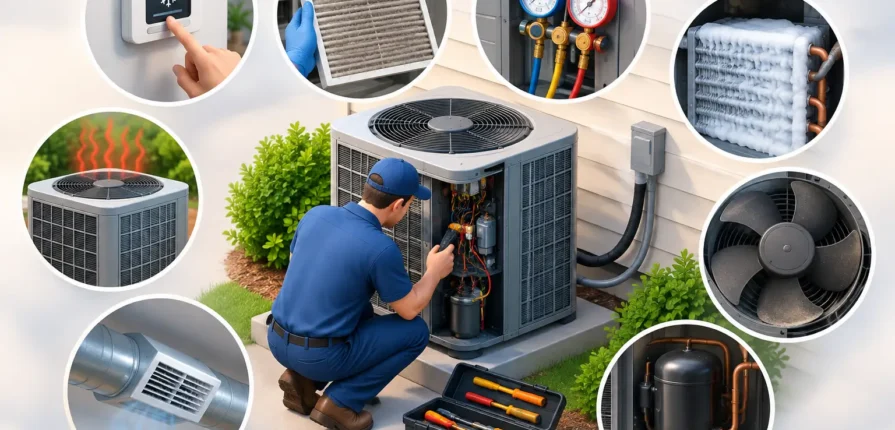
When your furnace quits during an Ohio cold snap or your AC starts blowing warm air in July, you need answers fast. These HVAC troubleshooting examples can help you spot simple issues, understand what may be happening, and know when it is time to call a qualified technician. A quick check can sometimes save a service call. It can also prevent you from overlooking a problem that could damage your equipment or create a safety risk.
Start With the Safe, Simple Checks
Before assuming the system has failed, check the thermostat. Make sure it is set to heat or cool, the temperature setting is where you expect it to be, and the batteries are not dead if your thermostat uses them. It sounds basic, but incorrect settings and weak batteries cause more no-heat and no-cooling calls than many homeowners expect.
Next, look at the air filter. A filter packed with dust restricts airflow, forces the equipment to work harder, and can lead to frozen AC coils, overheated furnaces, uneven temperatures, and higher utility bills. If the filter looks gray, matted, or bowed inward, replace it with the correct size and type.
You can also verify that the breaker has not tripped and that exterior unit disconnects are on. Reset a tripped breaker once if needed. If it trips again, stop there. Repeated electrical trips are not a nuisance to work around. They are a reason to schedule professional HVAC diagnostics.
HVAC Troubleshooting Examples for Air Conditioning Problems
1. The AC runs but blows warm air
Warm air from supply vents can come from a thermostat issue, a dirty filter, a frozen evaporator coil, low refrigerant, or a problem with the outdoor condenser. Start by checking the thermostat, filter, and breaker. Then walk outside and listen for the condenser. If the indoor blower runs but the outdoor unit is silent, electrical components such as a capacitor, contactor, or disconnect may be involved.
Do not keep lowering the thermostat to force the system to catch up. That will not make a refrigerant leak disappear or restart a failed component. If the unit is running but not cooling, a technician needs to test pressures, electrical readings, airflow, and system operation before recommending a repair.
2. Ice is forming on refrigerant lines or the indoor coil
Ice on the large copper line outside is a clear sign that something is wrong. Restricted airflow from a dirty filter or blocked return can cause freezing. Low refrigerant can do it too, as can a blower problem. Turn the cooling system off at the thermostat and set the fan to ON if it will run. This can help the coil thaw.
Do not chip at ice or run the system while it is frozen. That can damage the compressor, which is one of the most expensive parts of an AC system. Once it has thawed, schedule service to find the cause rather than treating the ice as the problem itself.
3. Water is leaking near the furnace or air handler
Your central AC removes moisture from the air, and that water has to drain somewhere. A clogged condensate drain line is a common cause of puddles around indoor equipment. If your system has a visible drain pan, look for standing water, but do not remove panels or pour chemicals into the unit.
A small drain blockage can become water damage quickly, especially in an attic, finished basement, or utility closet. Leaks may also come from a cracked drain pan, a failed condensate pump, or a frozen coil that is thawing. The repair depends on the source, which is why a proper inspection matters.
4. The outdoor unit hums but the fan will not turn
A humming condenser with a non-spinning fan may have a failed capacitor, fan motor issue, or electrical fault. Turn the system off and leave it off. The compressor can overheat if the fan is not moving air across the outdoor coil.
This is not a safe do-it-yourself repair. Capacitors can hold an electrical charge even after power is shut off. A trained technician can test the part, inspect wiring, and make sure a replacement addresses the actual failure.
HVAC Troubleshooting Examples for Furnace Problems
5. The furnace turns on, then shuts off after a few seconds
This short cycling often points to a dirty flame sensor, airflow restriction, thermostat problem, or an issue with the ignition sequence. A furnace needs to prove that it has a safe flame before it continues heating. If it cannot verify that flame, it shuts down as a safety measure.
Replacing the filter is a reasonable first step. Beyond that, avoid repeatedly restarting the furnace. A technician can inspect the flame sensor, burners, venting, gas pressure, safety switches, and control board. The right fix depends on what the furnace is actually doing during startup.
6. The furnace blows cool air
Cool air may simply mean the blower is running before the heat exchanger warms up, especially right after a heating cycle begins. But if the air stays cool, the furnace may not be igniting, may be overheating and shutting off its burners, or may have a thermostat or control problem.
Check that the thermostat fan setting is set to AUTO rather than ON. With the fan set to ON, it can circulate room-temperature air between heating cycles. If that setting is correct and the problem continues, call for service. Never attempt to adjust gas valves, burners, or internal safety controls yourself.
7. You smell gas or a burning odor
A brief dusty smell during the first heating cycle of the season can be normal. A persistent burning smell, smoke, visible scorching, or an electrical odor is not. Turn the system off and arrange an inspection.
If you smell natural gas, leave the building immediately. Do not operate switches, use a phone inside the home, or try to relight anything. Call your gas utility or emergency services from a safe location, then contact an HVAC professional once the immediate hazard has been addressed. If a carbon monoxide alarm sounds, get everyone outside and call emergency services right away.
Noisy HVAC Equipment Is Giving You a Clue
8. Banging, screeching, rattling, or whistling sounds
Different sounds point in different directions. A rattle could be a loose panel, debris near the outdoor unit, or a failing internal part. A high-pitched squeal may come from a blower motor or belt on older equipment. Banging can indicate loose or damaged components, while whistling often means airflow is being restricted through a dirty filter, undersized return, or closed vents.
Do not ignore new noises just because the system still runs. Small mechanical problems can turn into a failed motor, damaged blower wheel, or compressor issue if the equipment keeps operating under strain. Make note of when the sound happens – at startup, during operation, or at shutdown – because that detail helps speed up diagnosis.
When a Quick Check Becomes a Service Call
Homeowners can safely replace filters, change thermostat batteries, clear leaves away from an outdoor unit, and make sure vents are open. Most repairs beyond those basics require testing tools, electrical knowledge, and experience with gas-fired equipment or refrigerant systems.
Call for professional help when a breaker trips repeatedly, the system leaks water, ice forms, cooling or heating is weak, or you hear unusual noises. The same applies if rooms are consistently too hot or too cold, utility bills jump without a clear reason, or the system cycles on and off constantly. These are often early warnings, and handling them early is usually less expensive than waiting for a full breakdown.
For homeowners and property managers in the Delaware, Ohio area, Professional Trade Service can inspect the full system, explain the problem in plain language, and provide a clear repair recommendation. A second opinion can also make sense when a repair quote is large or a replacement recommendation comes without a thorough diagnosis.
A comfortable home should not depend on guesswork. If your system is showing one of these warning signs, shut it down when safety is a concern and get the right help before a small issue becomes an emergency.
Recent Comments