
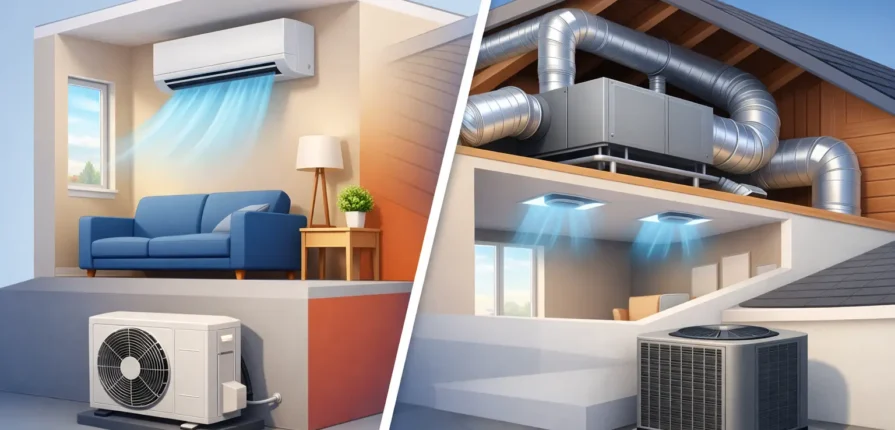
If your AC is struggling through another Ohio summer, this decision gets real fast. Homeowners comparing ductless mini split vs central air usually want a straight answer on cost, comfort, and whether one system will actually solve the problem without creating a new one.
The truth is, both systems can cool a home well. The better choice depends on your house, your ductwork, your budget, and how you actually use each room. A two-story home with hot upstairs bedrooms has different needs than a ranch with aging ducts. A finished addition or bonus room changes the math too.
Ductless mini split vs central air: what changes from one system to the other?
Central air uses one outdoor unit connected to an indoor coil and a duct system that moves cooled air through the house. It is the setup most homeowners already know. When it is designed and maintained properly, it delivers whole-home cooling from a single system and keeps the look of the home clean because the equipment is mostly out of sight.
A ductless mini split also has an outdoor unit, but instead of relying on ductwork, it uses one or more indoor air handlers mounted in specific rooms or zones. Each indoor unit cools the space where it is installed. That gives you room-by-room control, which is one of the biggest reasons people consider mini splits in the first place.
From a comfort standpoint, the biggest difference is control. Central air treats the home more like one connected space. Ductless systems let you fine-tune temperatures in separate areas. That can be a major advantage if family members never agree on the thermostat or if some parts of the house stay hotter than others.
When central air makes more sense
If your home already has ductwork in good condition, central air often gives you the most practical path to whole-home cooling. Installation is more straightforward when the duct system is already there and sized correctly. You get even air distribution, one main thermostat, and a familiar system that most buyers expect to see.
Central air also tends to be the better fit for larger homes where you want every room cooled consistently without putting a wall-mounted unit in each major space. Some homeowners simply prefer the hidden look of vents over visible indoor heads. That is a real consideration, not just a cosmetic one.
Another point in central air’s favor is filtration and airflow. A properly maintained central system can do a solid job circulating and filtering air across the whole house. If you already pair it with a furnace, the system can work as part of a more complete heating and cooling setup.
That said, central air is only as good as the duct system behind it. If your ducts leak, are undersized, or run through hot attic space with poor insulation, comfort and efficiency can drop fast. In those cases, replacing the AC without addressing the duct issues may leave you paying for a new system that still underperforms.
When a ductless mini split is the better call
A ductless mini split shines when ductwork is missing, impractical, or part of the problem. Additions, garages, sunrooms, finished basements, older homes, and upper-floor rooms with uneven cooling are common examples. In spaces like these, a mini split can solve comfort issues without the cost and disruption of adding new ducts.
This option also works well for households that do not use every room the same way. If the guest room sits empty most of the time or one office needs cooling all day while the rest of the home does not, zoning can reduce wasted energy. You cool the rooms you actually use instead of forcing the whole house into one temperature setting.
Mini splits are also known for high efficiency. Because there are no ducts, you avoid the losses that come with leaky or poorly insulated ductwork. Many systems can maintain a more steady indoor temperature rather than cycling hard on and off.
The trade-off is that indoor units are visible, and some homeowners never like that look. Multi-zone systems can also become expensive as you add more rooms. If you are trying to cool an entire larger home with several indoor heads, the cost can rise quickly and the layout has to be planned carefully.
Cost is not just the equipment price
This is where a lot of homeowners get frustrated. They want a simple answer on which system costs less, but the real answer depends on the house.
If you already have solid ductwork, central air may be more cost-effective for whole-home cooling. If your home has no ducts, or the existing ones are in poor shape, a ductless system can avoid major remodeling and may come out ahead. In older homes especially, tearing into walls and ceilings to add ductwork can turn into a bigger project than expected.
Operating cost is another piece of the puzzle. Ductless systems often win on efficiency, especially in homes where zoning makes sense. But if you run every indoor unit heavily all season, the savings may not be as dramatic as people hope. Central air can still be efficient when paired with proper duct sealing, insulation, and the right system size.
Repair and maintenance costs vary too. Central air has fewer visible components in living spaces, but duct issues can be expensive to track down and fix. Mini splits avoid duct losses, but they have multiple indoor units that each need cleaning and maintenance. Neither system is truly low-maintenance if you want it to last.
Comfort, noise, and daily use
On paper, both systems cool. In real life, comfort is about how the house feels at 6 p.m. on a 90-degree day.
Central air usually gives a more uniform feel across the home when the system is balanced well. It is easy to live with because it works in the background. You set the thermostat and let it run. For many families, that simplicity matters.
Ductless systems are often very quiet and can be excellent at holding a room right where you want it. They are especially good at solving hot and cold spots. If the upstairs bonus room is always uncomfortable, a mini split can target that problem directly instead of overcooling the entire first floor.
Still, room-by-room cooling is not always the same as whole-home comfort. Doors need to be open or zones need to be designed intentionally. If the goal is one system that cools every bedroom, hallway, and common area in a connected way, central air usually has the edge.
Ductless mini split vs central air for Ohio homes
Around central Ohio, the right choice often comes down to house age and layout. Newer homes with decent ductwork usually lean toward central air because the infrastructure is already there. Older homes, additions, converted spaces, and problem rooms often lean toward ductless because it solves a specific comfort issue without turning the project into a full renovation.
Humidity matters too. A properly sized system helps with moisture control as much as temperature. Bigger is not better. An oversized system can cool quickly without running long enough to remove enough humidity, leaving the house feeling cool but clammy. That applies whether you are looking at a mini split or central air.
This is one reason a real load calculation matters more than brand labels or online opinions. Good equipment installed wrong is still a bad result.
What homeowners should ask before deciding
Before you choose either system, look at the house honestly. Are the ducts in good shape, or are you trying to work around years of airflow problems? Are you cooling the whole home, or mainly trying to fix a few uncomfortable spaces? Do you care more about hidden equipment, or about room-by-room control?
Think about long-term plans too. If you expect to stay in the home for years, it may make sense to invest in the system that best fits how you live. If you are trying to improve comfort in one addition or upper floor right now, a mini split may be the smarter and faster solution.
A professional inspection helps because the answer is rarely one-size-fits-all. At Professional Trade Service, this is usually where the conversation gets easier. Once someone looks at the ductwork, insulation, square footage, and trouble spots, the better option starts to stand out.
The best HVAC decision is the one that fits your house instead of fighting it. If you choose based on layout, comfort needs, and real installation conditions, you are much more likely to end up with a system that feels right every day, not just one that sounded good on paper.
Recent Comments