
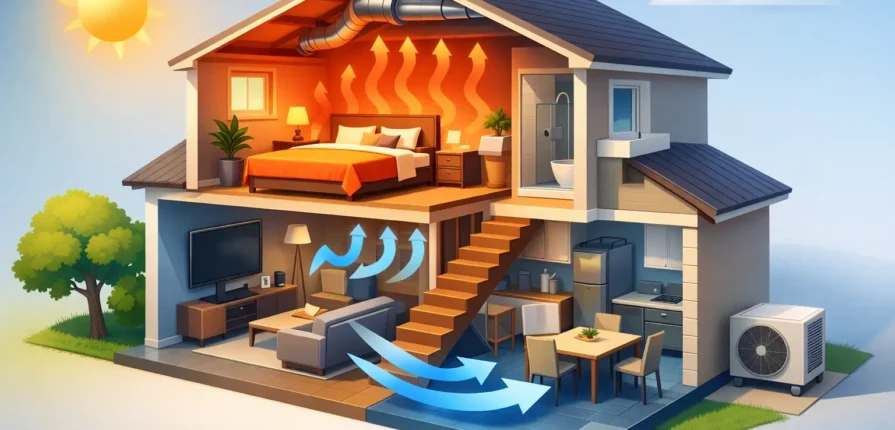
You set the thermostat, the AC kicks on, and the main floor feels decent. Then you head upstairs and it is a different story. If you have been asking, why is my upstairs hotter, you are dealing with one of the most common comfort complaints in Ohio homes, especially during the peak of summer.
The short answer is that heat rises, but that is rarely the whole problem. In most homes, an upstairs that stays too warm points to airflow issues, insulation problems, ductwork trouble, thermostat location, or an HVAC system that is struggling to keep up. Sometimes it is one simple fix. Sometimes it is a combination of small issues that add up.
Why is my upstairs hotter in the first place?
Second floors naturally collect more heat. Warm air rises through the house, and the upper level also sits closer to a hot attic and roof. On a sunny afternoon, that heat load can build fast. If your cooling system is not balanced well, the upstairs will show the problem first.
That does not automatically mean your air conditioner is broken. Many systems are cooling the house, just not evenly. A home can have a working AC and still have rooms upstairs that feel stuffy, humid, or 5 to 10 degrees warmer than the first floor.
The bigger question is why your system is not removing that extra heat effectively.
The most common reasons your upstairs stays hotter
Your system has airflow problems
Poor airflow is one of the biggest reasons upstairs rooms stay warm. If not enough conditioned air reaches the second floor, those rooms will never catch up, no matter how long the AC runs.
Sometimes the issue is basic. A dirty air filter can reduce airflow through the whole system. Closed or blocked supply vents can also limit cool air where you need it most. In other cases, the blower may be underperforming, or the duct system may not be distributing air properly.
Low airflow often shows up as weak air coming from upstairs vents, longer run times, and uneven room temperatures.
Your ductwork is leaking or poorly designed
Ductwork matters more than most homeowners realize. If ducts running to the second floor are leaking in the attic, crawl space, or wall cavities, a portion of your cooled air is getting lost before it ever reaches the room.
Some homes also have duct systems that were never balanced correctly to begin with. The downstairs gets plenty of air, while the upstairs is left short. That can happen in older homes, additions, or houses where the equipment was replaced but the ductwork was never corrected.
This is one of those problems that usually does not improve on its own. If your upstairs has always been warmer, poor duct design may be part of the reason.
The attic is holding too much heat
A superheated attic puts constant pressure on the upstairs. If the attic has poor insulation, inadequate ventilation, or air leaks around fixtures and wall openings, that trapped heat transfers into the rooms below.
You may notice this more in bedrooms with sloped ceilings, bonus rooms over garages, or spaces with a lot of afternoon sun. The AC may be running normally, but the upstairs keeps gaining heat faster than the system can remove it.
In that case, the HVAC system is not the only thing worth checking. Sometimes the real fix involves insulation and attic ventilation improvements, not just AC service.
The thermostat is in the wrong spot
If your thermostat is downstairs, it is reading the temperature where the air is cooler. Once the first floor reaches the set point, the system shuts off, even if the upstairs is still uncomfortable.
That is a common reason people ask, why is my upstairs hotter than downstairs, even though the AC seems to be turning on and off normally. The equipment may be doing exactly what the thermostat tells it to do. The problem is that the thermostat is not measuring the hottest part of the house.
Zoned systems, smart thermostats with remote sensors, or airflow adjustments can help here. But it depends on how your home is laid out and what kind of system you have.
Your AC system is undersized, aging, or not operating at full capacity
If the air conditioner is too small for the home, or if it has lost performance due to age, wear, low refrigerant, dirty coils, or electrical issues, the upstairs usually suffers first.
You may still get some cooling downstairs, which makes the problem feel confusing. Homeowners often assume the system is working fine because part of the house feels okay. But partial comfort is not the same as proper performance.
An aging system may also run constantly without bringing the upstairs temperature down. If that sounds familiar, it is worth having the equipment checked before a minor performance issue becomes a full breakdown.
What you can check before calling for service
There are a few practical things you can look at first.
Start with the air filter. If it is dirty, replace it. Check that all upstairs supply vents are open and not blocked by furniture, rugs, or curtains. Make sure return vents are clear too. Restricted return air can throw off the whole system.
Then look at your windows. Heavy sun through upstairs windows can add more heat than people expect. Blinds, curtains, and window coverings can help reduce heat gain during the hottest part of the day.
You can also compare airflow room to room. If one upstairs vent blows much weaker than another, that points to a duct or balancing issue. If all the upstairs vents feel weak, the problem may be more system-wide.
If your attic access is easy and safe, look for obvious signs of trouble like missing insulation or extreme attic heat buildup. You do not need to diagnose it yourself, but visible gaps or thin insulation can tell you a lot.
When the fix is simple and when it is not
Some upstairs temperature issues come down to maintenance. A clogged filter, dirty equipment, or minor airflow restriction can be corrected fairly quickly.
Other cases take more than a quick adjustment. Duct leaks, poor attic insulation, lack of zoning, or improper system sizing usually need a more complete solution. That is where honest diagnostics matter. You do not want someone guessing. You want to know whether the issue is the equipment, the ductwork, the house itself, or a mix of all three.
There is also a trade-off to keep in mind. Cranking the thermostat lower might help the upstairs a little, but it can leave the downstairs too cold and drive up energy bills. That is not a real fix. It is just asking the system to work harder around an imbalance.
Why is my upstairs hotter even with a newer AC?
A newer air conditioner does not guarantee even temperatures. If the underlying issue is duct design, insulation, thermostat placement, or lack of zoning, a new unit can still leave the second floor uncomfortable.
This happens more often than homeowners expect. Someone replaces the AC thinking the old one was the whole problem, but the upstairs still runs hot because the airflow and heat load were never addressed.
That is why a good service call should look at the full picture, not just the outdoor unit. A proper diagnosis includes airflow, duct condition, system performance, and how the home handles heat.
When it is time to bring in an HVAC technician
If your upstairs is consistently warmer by several degrees, if airflow is weak, if the AC runs constantly, or if your utility bills keep climbing, it is time to have the system checked. The same goes if this is a newer problem and your house did not used to feel this uneven.
For homeowners in Central Ohio, summer heat and humidity can expose weaknesses in a system fast. What feels like a small comfort issue in June can turn into a no-cooling call in July. A technician can test system performance, inspect ductwork, check refrigerant and electrical components, and help determine whether the answer is repair, adjustment, or a larger upgrade.
At Professional Trade Service, this is the kind of problem we see all the time. Sometimes the fix is straightforward. Sometimes it takes a broader plan to get the home comfortable on both floors. Either way, the goal is the same: find the actual cause and fix it right the first time.
If your upstairs is hotter than the rest of the house, do not assume you just have to live with it. Uneven cooling is usually a sign that something in the system or the home needs attention, and the sooner you catch it, the easier it is to get comfortable again.
Recent Comments