
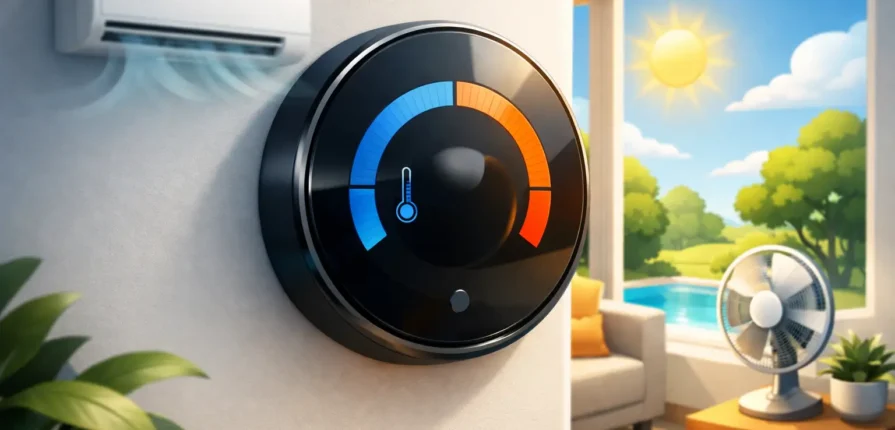
When the first stretch of 90-degree weather hits Ohio, a lot of homeowners do the same thing – they crank the thermostat down and hope the house cools faster. That usually leads to higher electric bills, longer AC run times, and more wear on the system. The best thermostat settings for summer are the ones that keep your home comfortable without making your air conditioner work harder than it needs to.
There is no single number that works for every house, every family, or every system. A newer home with good insulation will handle heat differently than an older house with leaky windows or hot second-floor bedrooms. The goal is to find a setting that balances comfort, humidity control, and energy use.
Best thermostat settings for summer at home
For most homes, 78 degrees is a solid starting point when you are home and need regular comfort. That setting is widely recommended because it helps control energy costs without making the house feel too warm for most people. If 78 feels high in your home, 76 or 77 may be a better fit. If your house stays comfortable at 79 because of good insulation, ceiling fans, or shade, that can save even more.
What matters is understanding that every degree lower can raise cooling costs. Setting the thermostat to 70 does not cool the house faster. It only tells the system to keep running until it reaches that lower temperature. On very hot days, that can mean long cycles, higher bills, and more stress on an already hard-working AC unit.
If you are trying to find the best thermostat settings for summer, start with 78 and live with it for a few days. Pay attention to how the house feels in the afternoon, whether humidity seems under control, and whether anyone in the home is uncomfortable. Then adjust by one degree at a time.
A good schedule for day and night
A practical summer schedule looks different depending on whether someone is home during the day. If the house is empty for several hours, raising the thermostat to 82 to 85 can cut cooling costs without risking the home. Then you can program it back down before everyone returns.
At night, many people sleep better in a cooler room. A setting around 74 to 76 is common for sleeping, especially if bedrooms are upstairs where heat tends to collect. If you have a programmable or smart thermostat, this is where it really helps. Instead of constantly adjusting the temperature by hand, you can let the schedule do the work.
When to raise the temperature in summer
It makes sense to raise the thermostat when the house is empty, but there is a limit. If you set it too high, the AC may have to run hard for a long time to pull the house back down to a comfortable level. In some homes, especially older ones, that can erase some of the savings.
A moderate setback usually works best. Raising the temperature 4 to 7 degrees while you are away is often enough. For example, if you like 77 when you are home, setting it to 82 or 84 while you are out is reasonable. That approach lowers energy use without forcing the system into a major recovery cycle.
Humidity is the other piece people forget. In Ohio summers, the air can get sticky fast. If your thermostat is set too high for too long, indoor humidity may climb, and the house can feel uncomfortable even after the temperature drops. If that is happening, your home may need a smaller temperature setback, better air sealing, or an AC inspection to make sure the system is removing moisture the way it should.
Smart thermostats can help, but they are not magic
A smart thermostat is useful if your schedule changes often or you want better control over energy use. It can learn patterns, adjust settings automatically, and let you change temperatures from your phone. That said, it will not fix poor airflow, duct leaks, dirty filters, or an undersized system.
If certain rooms never cool properly, the thermostat may not be the real issue. We see that a lot in homes with blocked vents, weak attic insulation, aging equipment, or systems that are overdue for service. The thermostat gets blamed because it is the part you see, but the problem is often elsewhere.
How fans and humidity affect summer settings
The temperature on the thermostat is only part of comfort. Air movement matters too. Ceiling fans can make a room feel several degrees cooler, which means you may be perfectly comfortable at 78 instead of 75. That is real savings over the course of a long summer.
Just remember that fans cool people, not rooms. Running ceiling fans in empty rooms only adds to your electric use. Use them where people are actually spending time.
Humidity also changes how a house feels. A home at 76 with high humidity can feel worse than a home at 78 with proper moisture control. If your AC runs but the house still feels damp or sticky, that is a sign worth paying attention to. It could point to a maintenance issue, low refrigerant, airflow problems, or a system that is too large and cools the home too quickly without enough dehumidification.
Signs your thermostat setting is not the real problem
Sometimes homeowners keep lowering the thermostat because the house never feels right. If that sounds familiar, the issue may not be the setting itself. Watch for warm spots, weak airflow, short cycling, rising utility bills, or an AC that runs all afternoon and still cannot keep up.
Those are signs your system may need service. A dirty coil, clogged filter, failing capacitor, refrigerant issue, or thermostat calibration problem can all affect comfort. In older homes around Delaware and nearby central Ohio communities, insulation and ductwork problems are also common. Lowering the thermostat will not fix any of that. It only masks the symptom for a while.
Best thermostat settings for summer by situation
The right setting depends on the people in the house and the condition of the home. Families with small children, older adults, or medical needs may need cooler settings for safety and comfort. People who work from home usually need a lower daytime setting than someone who is gone from 8 to 5. A two-story home with sunny bedrooms may need a different schedule than a ranch home with good shade.
Here is a practical way to think about it. If you are home, try 76 to 78. If you are away, try 82 to 85. If you are sleeping, try 74 to 76. Then adjust based on comfort, humidity, and how hard your system seems to be working.
If you have pets, the same common-sense rule applies. Most homes do not need to be kept extremely cold during the day just because a pet is inside, but you also do not want indoor temperatures climbing too high. In most cases, a setting around 78 to 82 while you are gone is reasonable, assuming your system is reliable and the home is not prone to overheating.
Small changes that lower cooling costs
Thermostat settings matter, but they work best along with basic system care. A clean filter helps airflow. Closed blinds on sunny windows reduce heat gain. Weatherstripping and attic insulation help keep cool air in the house. A seasonal AC tune-up can catch problems before they turn into a breakdown during the hottest week of the year.
This is where experience matters. If your system struggles every summer, a technician should look at more than just the thermostat. Sizing, airflow, duct condition, refrigerant charge, and overall equipment health all play a role. Professional Trade Service works with homeowners who want straight answers, not guesswork, and that is often what it takes to solve comfort problems for good.
A good thermostat setting should help your house feel steady, not force your AC into a constant fight against the weather. If you are making big adjustments every day, or your bill keeps climbing without better comfort, it may be time to look beyond the number on the wall. The right setting is the one that keeps your home comfortable, your humidity under control, and your system from running itself into an early repair call.
Recent Comments