
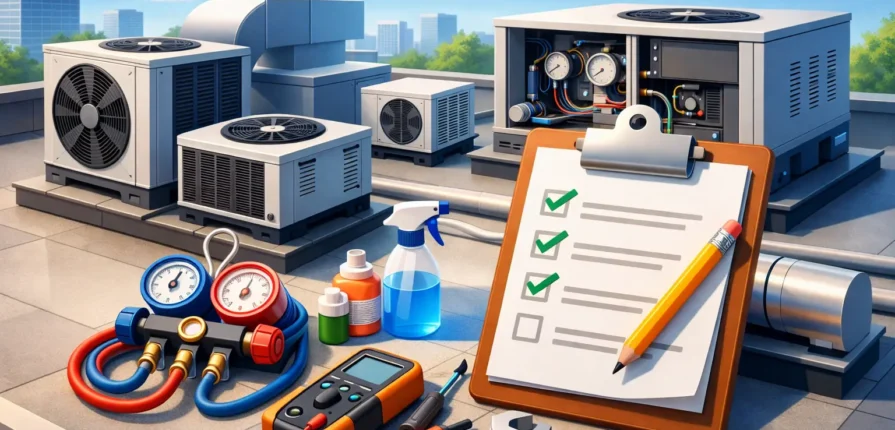
A rooftop unit usually does not fail on a mild day when nobody is paying attention. It quits during a heat wave, before a tenant walkthrough, or right before your busiest shift. That is why a solid commercial hvac maintenance checklist matters. It gives property managers and business owners a clear way to catch small issues before they turn into expensive downtime, comfort complaints, or emergency repair calls.
What a commercial HVAC maintenance checklist should actually do
A good checklist is not just a form to fill out and file away. It should help you protect equipment life, keep utility costs under control, and reduce the odds of a no-cool or no-heat call when your building needs steady performance most.
For commercial properties, maintenance also has more moving parts than a typical home system. You may be dealing with rooftop units, split systems, makeup air, thermostats in different zones, tenant comfort issues, and equipment that runs longer hours than residential systems ever would. That means your checklist needs to cover condition, performance, safety, and documentation.
If you manage a light commercial building, retail space, office, restaurant, or mixed-use property, the right checklist should answer four basic questions. Is the system clean, is it operating correctly, is it safe, and is anything starting to fail?
The core commercial HVAC maintenance checklist
Start with the air filters. Dirty filters are one of the most common causes of reduced airflow, comfort complaints, frozen coils, and unnecessary strain on the blower motor. In some buildings, filters may need attention monthly, not just seasonally. It depends on occupancy, dust levels, and hours of operation.
Next, inspect belts, pulleys, and motors. Worn belts can slip and reduce airflow, and motor issues can show up first as noise, heat, or vibration. Catching these early is usually far cheaper than waiting for a shutdown.
Coils need close attention too. Evaporator and condenser coils collect dirt over time, and even a light buildup can reduce heat transfer and force the equipment to work harder. That means longer run times, higher electric bills, and more wear on the system.
Electrical components should be checked for tight connections, signs of overheating, damaged wires, and failing capacitors or contactors. Commercial equipment takes a beating over time, especially during heavy summer and winter use. This is an area where preventive maintenance often prevents a true emergency.
Drain lines and drain pans should be cleared and inspected. A clogged condensate line can lead to water damage, musty odors, or system shutdowns. In some commercial spaces, that kind of moisture problem can also affect ceiling tiles, flooring, or nearby equipment.
Thermostats and control systems should be tested for proper calibration and response. If a unit is cooling but the space still feels uncomfortable, the issue may be with controls, sensors, or zoning rather than the core equipment itself.
Refrigerant levels and operating pressures should be checked as part of a full service visit. Low refrigerant does not just hurt cooling performance. It can point to a leak, and continuing to run the equipment that way can damage the compressor.
The checklist should also include inspection of the blower assembly, fan blades, bearings, dampers, disconnects, safety controls, and visible duct connections. On gas heat, burners, ignition, flame condition, heat exchangers, and venting all need proper review before cold weather sets in.
Seasonal maintenance matters more than most owners think
Cooling season priorities
Before summer, commercial cooling equipment should be cleaned, tested, and measured under load. That includes condenser coil cleaning, refrigerant checks, electrical testing, thermostat operation, and airflow review. If your building has had hot spots, humidity issues, or rising energy bills, preseason service is the time to address them.
Waiting until the first ninety-degree stretch is risky. By then, service demand is high and every small weakness in the system is more likely to show up as a breakdown.
Heating season priorities
Before winter, the focus shifts to burners, ignition systems, heat exchangers, safeties, flue venting, and overall heating performance. A furnace or rooftop heat section that has sat idle for months should never be assumed ready without inspection.
This is also the right time to check for unusual cycling, uneven heating, and thermostat problems in different zones. In commercial spaces, those comfort issues often turn into employee complaints or tenant calls fast.
What gets missed on many maintenance visits
A checklist only helps if it goes beyond the obvious. Plenty of quick tune-ups cover filters and a visual once-over, but commercial systems often need a more careful approach.
Airflow is a common blind spot. A unit can be running and still perform poorly because of dirty coils, weak blower performance, blocked returns, failing dampers, or duct leakage. Without checking airflow and temperature split, you may miss the real reason a space never seems comfortable.
Documentation is another one. If the same capacitor gets weak every year, or one zone keeps falling behind, that pattern matters. Maintenance records help you spot equipment that is becoming unreliable so you can plan a repair or replacement before it fails at the worst possible time.
Roof conditions also matter for rooftop units. Curbs, panels, seals, and access points should be inspected. Water intrusion, corrosion, or vibration damage around the unit can turn into a bigger building problem if nobody catches it early.
A checklist should lead to action, not just inspection
The best commercial hvac maintenance checklist does more than note problems. It helps you decide what needs immediate repair, what should be scheduled soon, and what simply needs monitoring.
That distinction matters for budget planning. Not every issue is a same-day emergency, but not every issue should wait either. A weak contactor in peak summer, for example, might still be running today and fail tomorrow. On the other hand, minor surface rust on an older cabinet may be something to watch rather than replace right away.
This is where honest service matters. You want a technician who can explain what is worn out, what is affecting performance, and what is safe to postpone for a short time. Straight answers help property owners avoid both overspending and costly delay.
How often should commercial HVAC be maintained?
For many light commercial properties, twice-a-year service is the starting point – once before cooling season and once before heating season. That works well for standard office spaces and similar buildings with normal operating hours.
But some systems need more attention. Restaurants, dusty workspaces, buildings with long daily runtimes, and properties with older equipment may need quarterly maintenance. If the building has frequent comfort complaints or repeat repairs, more frequent service is usually money well spent.
It also depends on the age and condition of the equipment. Newer systems may need less corrective work, but they still need regular inspection to protect warranty coverage and long-term efficiency. Older systems often need closer tracking because one worn part can put stress on several others.
Signs your current maintenance plan is not enough
If utility bills keep climbing without a clear reason, your maintenance may be too light or too inconsistent. The same goes for rooms that are always too hot or too cold, repeated breaker trips, musty smells, short cycling, or equipment that needs repairs every peak season.
Another warning sign is when nobody can tell you the last time coils were cleaned, electrical readings were taken, or refrigerant was checked. That usually means maintenance has been reactive instead of preventive.
For businesses in places like Lewis Center or Sunbury, where summer heat and winter cold both put real stress on HVAC equipment, seasonal neglect tends to show up fast. A missed issue in spring can become an emergency call in July.
Choosing a checklist that fits your building
Not every property needs the exact same maintenance plan. A small office with one packaged unit is different from a retail building with multiple zones and longer operating hours. The checklist should match the equipment type, the age of the system, occupancy demands, and how costly downtime would be for your business.
That is why a one-size-fits-all service visit can fall short. A proper commercial maintenance plan should be built around how your building actually runs. Professional Trade Service works with that real-world mindset – find what is likely to cause problems, fix what needs attention, and keep the system dependable when your building cannot afford downtime.
A checklist is only useful if somebody follows it carefully and explains what they found in plain language. If your commercial HVAC system has been getting by on quick inspections and crossed fingers, now is a good time to tighten up the plan before the next weather swing tests it.
Recent Comments