
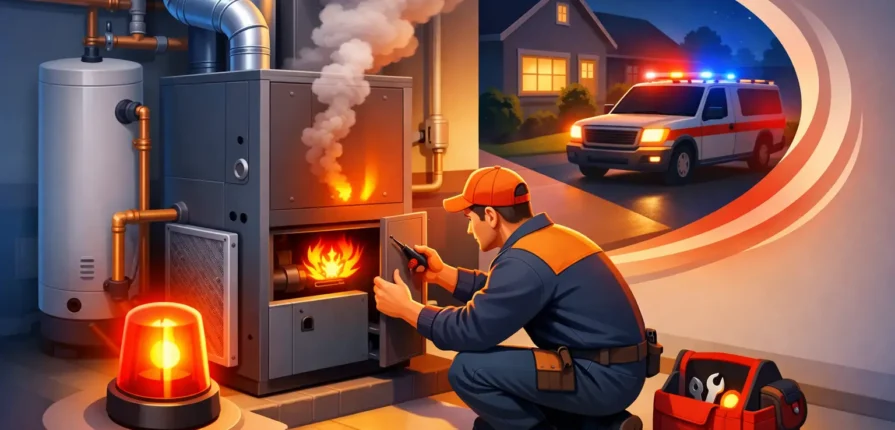
When your house goes cold at 2 a.m. and the furnace quits, you are not looking for theory. You are searching emergency furnace repair near me because you need heat back, you need straight answers, and you need to know whether the problem is dangerous or just inconvenient. In Ohio, that distinction matters fast.
A furnace breakdown is never just about comfort. If the temperature drops enough, pipes can freeze, indoor air quality can suffer, and vulnerable family members can be put at risk. For property managers and business owners, a failed heating system can also mean tenant complaints, shutdowns, and damage that spreads far beyond one repair bill.
What counts as an emergency furnace repair?
Not every furnace issue needs a middle-of-the-night call, but plenty do. If your system will not start and the indoor temperature is falling quickly, that is an emergency. The same goes for a furnace that is blowing cold air during freezing weather, repeatedly tripping the breaker, shutting off after a few minutes, or making loud banging or screeching noises that were not there before.
There is also the safety side. If you smell gas, notice a burning odor that does not clear quickly, see soot around the unit, or suspect carbon monoxide, do not wait and see what happens. Leave the area if needed, shut off the system if it is safe to do so, and call for help right away. A good heating company will tell you plainly whether the situation sounds urgent and what steps to take before the technician arrives.
Before you call for emergency furnace repair near me
There are a few basic checks worth doing because they can save time, and in some cases, save you the cost of an emergency dispatch. Keep it simple and stay safe.
Start with the thermostat. Make sure it is set to heat, the temperature setting is above the current room temperature, and the batteries are not dead if your model uses them. It sounds obvious, but thermostat problems cause plenty of no-heat calls.
Next, check the breaker panel. A tripped breaker may point to an electrical issue, but sometimes it is a one-time interruption. Reset it once. If it trips again, stop there and call a professional. Repeated trips are a warning sign, not something to push through.
Then look at the filter. A clogged filter can restrict airflow enough to overheat the system and force a shutdown. If the filter is dirty, replace it and give the furnace a few minutes to restart. Also check that the furnace switch is on and that intake or exhaust vents outside are not blocked by snow, ice, or debris.
If you have a gas furnace, verify that the gas supply valve is in the proper position. Do not start taking apart panels or trying to relight components unless you know exactly what you are doing. Emergency repairs get more expensive when a simple fault turns into damage from guesswork.
What a technician is usually looking for
When a furnace fails suddenly, the root cause is often one of a handful of common problems. Ignition failures are near the top of the list, especially in older systems. If the ignitor or pilot assembly is not working, the furnace cannot produce heat.
Dirty flame sensors are another frequent issue. A furnace may start briefly and then shut back down because the sensor is not confirming a proper flame. Blower motor problems, failed capacitors, limit switch faults, control board issues, and clogged condensate lines on high-efficiency units can also stop a system cold.
Sometimes the repair itself is straightforward, but access to the right part is what determines how long you are without heat. That is one reason local service matters. A contractor with real emergency experience knows which parts fail most often in winter and stocks for the calls that happen after normal business hours.
Why fast service matters more than people think
A lot of homeowners try to wait until morning, hoping the house will hold temperature. Sometimes that works. Sometimes it does not. Ohio winters can turn a manageable inconvenience into a serious home problem in a matter of hours, especially in older houses with less insulation or properties sitting vacant.
The trade-off is cost. Emergency service can carry a higher rate than a daytime visit, depending on the company and the hour. But delaying service can cost more if frozen pipes, water damage, or a complete system failure follows. The right choice depends on the indoor temperature, the age of the system, who is in the home, and whether you have any backup heat.
For families with infants, older adults, or anyone with health concerns, a no-heat situation is rarely something to stretch out. For landlords and commercial properties, waiting can create liability and upset tenants or staff. Fast service is not about convenience alone. It is often the least expensive way to limit the fallout.
What to expect from a good emergency call
A solid emergency HVAC company should be clear from the first phone call. You should get a realistic arrival window, direct questions about symptoms, and basic safety guidance if there is any sign of gas or electrical trouble. Once on site, the technician should inspect the system, explain the problem in plain language, and tell you what can be done right now versus what may need follow-up.
This is where experience shows. A seasoned tech does not just swap parts and hope. They check airflow, controls, ignition, venting, and system condition as a whole. That matters because emergency failures are not always isolated. A cracked heat exchanger, failing blower motor, or neglected maintenance issue can show up as one symptom while hiding a larger problem.
Transparent pricing matters too. Nobody likes surprise charges during a no-heat call. Honest companies explain the repair, the cost, and whether the furnace is worth fixing if the unit is already near the end of its service life.
Repair or replace? It depends on the furnace
During an emergency, most people just want the quickest fix. That is understandable, and often the right move. But there are times when a repair does not make financial sense.
If your furnace is 15 to 20 years old, needs an expensive part, has a history of breakdowns, or is driving up utility bills, replacement may be the smarter long-term decision. If the issue involves a major safety concern, that conversation becomes even more serious. On the other hand, if the system has been reliable and the repair is reasonable, fixing it is often the best path.
A trustworthy contractor will walk through both options without pressure. They should be able to stabilize the immediate problem when possible, then talk honestly about whether you are putting money into a system that is likely to fail again.
How to lower the odds of another emergency
Most furnace emergencies do not come completely out of nowhere. Many are tied to skipped maintenance, dirty filters, worn parts, or small performance issues that were easy to ignore in milder weather.
Seasonal tune-ups help catch those problems before they become after-hours breakdowns. A proper heating inspection can spot weak ignition components, airflow restrictions, cracked hoses, loose wiring, and safety issues before winter puts your system under full load. Regular maintenance also gives you a clearer picture of the furnace’s condition, so you are not making major decisions in the middle of a cold snap.
For homeowners with older equipment, maintenance is even more important. For property managers, it is one of the simplest ways to reduce emergency calls across multiple units. And for anyone balancing repair costs against a tight budget, prevention is usually cheaper than urgent service.
In central Ohio communities like Sunbury and Lewis Center, winter demand can stack up quickly when temperatures plunge. Working with a local company that handles heating, and can also help if a breakdown leads to electrical or plumbing concerns, can save time when the problem is bigger than just the furnace. That one-call approach is part of why many local homeowners keep Professional Trade Service on their radar during the heating season.
Choosing the right local company when heat cannot wait
When you are searching for emergency help, do not overcomplicate it. Look for a company that offers true 24/7 availability, not just voicemail after hours. Look for experience with both residential and light commercial systems. Look for clear communication, real diagnostics, and a reputation for showing up when people need them most.
The cheapest call is not always the best call, especially at night. You want a repair that is safe, complete, and based on the actual cause of the failure. You also want someone who will tell you if a temporary fix is all that is possible until a part arrives, rather than pretending every emergency can be solved in one visit.
When your furnace quits, speed matters, but so does judgment. The best emergency service is not just fast. It is calm, capable, and honest enough to help you make the right call for your home, your budget, and the people depending on that heat.
Recent Comments