
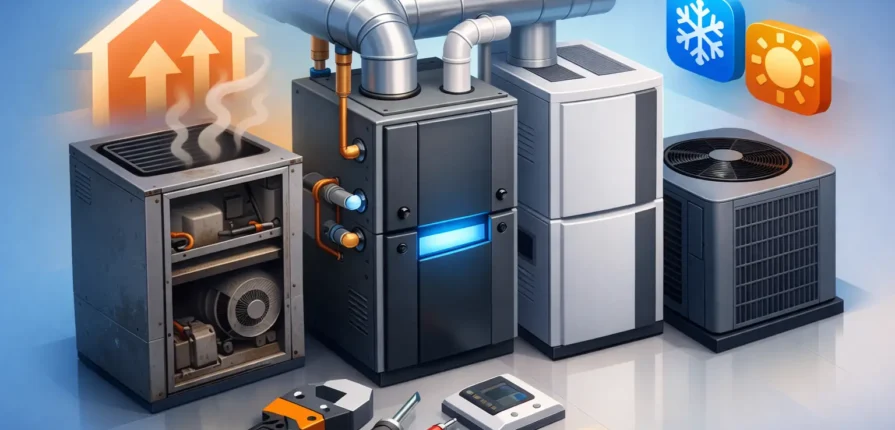
That old furnace usually gives you a little warning before it quits for good. Maybe the heat is uneven, the blower sounds rough, or your utility bills keep climbing even though your thermostat habits have not changed. If you are looking for a guide to furnace replacement options, the real question is not just what unit to buy. It is what system makes sense for your home, your budget, and the way you actually use heat in an Ohio winter.
A furnace replacement is one of those decisions that feels simple until you start seeing model numbers, efficiency ratings, fuel types, and price ranges all at once. Some homes need a straightforward swap. Others need ductwork changes, venting updates, or a full look at the heating and cooling system together. The best choice depends on more than the age of the equipment.
When replacement makes more sense than repair
Not every heating problem means you need a new furnace. A bad ignitor, failed blower motor, dirty flame sensor, or faulty thermostat can often be repaired without replacing the whole system. But there comes a point when more repair money stops being the smart move.
Age is a big factor. Many furnaces can last 15 to 20 years with proper maintenance, but performance usually drops as parts wear down. If your furnace is in that range and needs an expensive repair, replacement is worth a serious look. The same goes for systems that break down repeatedly, struggle to keep up in colder weather, or create hot and cold spots throughout the house.
Safety matters too. Cracked heat exchangers, combustion issues, or venting problems should never be brushed off. In those cases, replacement can be the better long-term answer, especially if the unit is already near the end of its service life.
Guide to furnace replacement options by system type
Most homeowners start by comparing the main types of furnaces. The right fit depends on your utility setup, the condition of your current system, and how much you want to invest upfront versus over time.
Natural gas furnaces
In many central Ohio homes, natural gas is the most common and cost-effective choice. Gas furnaces heat quickly, perform well in cold weather, and often have lower operating costs than electric resistance heat. If your home already has a gas line and venting in place, replacing an older gas furnace with a newer one is often the most direct option.
The trade-off is that gas systems need proper combustion, venting, and safety controls. Installation quality matters. A poorly sized or poorly installed gas furnace can waste energy and create comfort problems even if the equipment itself is good.
Electric furnaces
Electric furnaces usually cost less to buy and install than gas models, and they do not require combustion venting. That can make them attractive in homes without natural gas service or in certain light commercial settings.
The downside is operating cost. In cold climates, electric resistance heat can become expensive fast. For some property owners, the lower upfront price is offset by higher winter utility bills. Electric furnaces can still make sense, but they need to be evaluated honestly against your local utility rates and heating demand.
Oil furnaces
Oil heat is less common than it used to be, but some homes still rely on it. Oil furnaces can produce strong heat, which some homeowners like during very cold stretches. If you already have an oil system, replacing it with another oil furnace may be possible.
That said, many property owners use replacement time as a chance to compare switching to gas or another option. Oil systems come with fuel storage, delivery planning, and maintenance considerations that some people want to move away from.
Propane furnaces
For homes without natural gas access, propane can be a solid option. Propane furnaces offer heating performance similar to natural gas models, but fuel pricing can vary more. If you are considering propane, look beyond installation cost and think about long-term fuel expense, tank setup, and supply logistics.
High-efficiency vs standard-efficiency models
One of the biggest decisions in any guide to furnace replacement options is efficiency. This is usually measured by AFUE, which tells you how much fuel becomes usable heat.
An older furnace may run at 60 to 80 percent AFUE. Newer standard units are better, and high-efficiency furnaces can reach 90 percent or much higher. That sounds like an easy decision, but there are trade-offs.
A high-efficiency furnace can lower fuel usage and may pay off well if you plan to stay in the home, especially if your current unit is very old. It can also improve comfort because many higher-end systems offer better airflow control and more consistent heating.
But higher efficiency usually means higher upfront cost. It may also require venting changes, condensate drainage, or other installation updates. In some homes, the payback is clear. In others, a mid-efficiency or carefully selected standard replacement may be the more sensible budget move.
Single-stage, two-stage, and variable-speed performance
Not all furnaces heat the same way. This part gets overlooked, but it affects comfort more than many homeowners expect.
A single-stage furnace is the simplest option. It is either on or off, running at full capacity when heat is needed. These systems are usually the least expensive upfront and can work well in smaller homes or tighter budgets.
A two-stage furnace has a low setting and a high setting. Most of the time, it runs on the lower stage, which helps maintain steadier indoor temperatures and can reduce temperature swings. When outdoor temperatures drop hard, it steps up to full output.
Variable-speed systems offer even more control. They can adjust airflow more precisely, improve humidity management, and make the home feel more even from room to room. They also tend to run quieter. The trade-off is cost. For some households, the comfort improvement is worth every dollar. For others, a two-stage system hits the sweet spot.
Size matters more than brand slogans
A furnace that is too small will struggle to keep up. A furnace that is too large can short cycle, wear out faster, and create uneven heat. Bigger is not better.
Proper sizing should be based on the home itself, not just the size of the old unit. Square footage matters, but so do insulation levels, window quality, ceiling height, duct condition, and air leakage. If a contractor gives a replacement quote without evaluating those factors, that is a red flag.
This is also where installation quality separates a good replacement from an expensive headache. The right equipment installed poorly will not perform the way it should.
Should you replace only the furnace or the full system?
Sometimes a furnace can be replaced on its own. Other times, it makes sense to look at the air conditioner, heat pump, thermostat, and duct system at the same time.
If your air conditioner is also older, replacing both systems together may improve efficiency and avoid paying for labor twice. Matched systems can perform better, and in some cases, upgrading controls or airflow components can solve comfort issues that a furnace swap alone will not fix.
If the cooling side is newer and in good shape, a furnace-only replacement may be perfectly reasonable. It depends on age, condition, compatibility, and budget.
What affects furnace replacement cost
Homeowners usually want a ballpark price right away, and that is fair. But furnace replacement cost can vary widely because the equipment is only part of the job.
Fuel type, efficiency level, system size, staging features, venting changes, thermostat upgrades, electrical work, and duct modifications all affect the final number. Access can matter too. A basement install is different from a tight attic or crawl space setup.
The cheapest quote is not always the best value. If one price is dramatically lower than the others, ask what is missing. That could mean lower-grade equipment, less installation work, limited warranty support, or no plan for correcting airflow and venting problems.
Questions to ask before you choose
Before you sign off on a replacement, ask a few plain questions. Is the system sized for the house, or is it just matching the old unit? What efficiency gain should you realistically expect? Will the install require venting, drain, or electrical updates? Is your ductwork helping or hurting performance? And if you are comparing repair versus replacement, how much life is truly left in the current furnace?
A good contractor should be able to answer those questions without talking around them. Straight answers matter, especially when you are making a major home expense under time pressure.
The best furnace replacement option is the one that fits your house
There is no single best furnace for every home. A reliable gas furnace may be the clear winner for one homeowner, while another may be better served by electric heat, propane, or a broader system upgrade. What matters is choosing equipment that fits the home, the utility setup, the budget, and your expectations for comfort.
If your current furnace is getting loud, unreliable, or expensive to keep alive, this is the time to look at replacement with a clear head instead of waiting for a total breakdown in the middle of winter. The right choice is rarely the flashiest one. It is the one that heats your home safely, runs efficiently, and gives you fewer problems when the temperature drops.
Recent Comments