
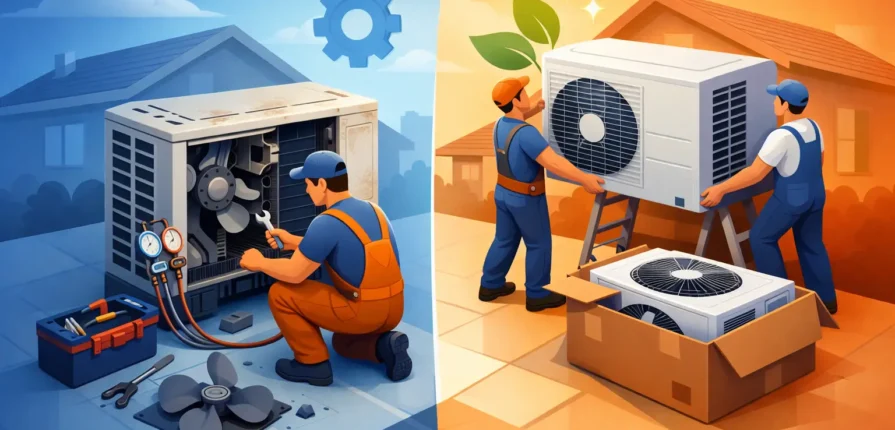
When your AC quits on a 90-degree afternoon, the question gets real fast: repair vs replace aging air conditioner. Most homeowners do not need a sales pitch in that moment. They need a straight answer about cost, reliability, and whether putting more money into an older system still makes sense.
The truth is, there is no one-size-fits-all rule. Some older air conditioners are worth repairing, especially if the problem is minor and the system has been maintained. Others are already on borrowed time, and another repair only delays a bigger failure. The right call depends on age, repair history, efficiency, refrigerant type, and how the system is performing in your home.
Repair vs replace aging air conditioner: start with the age
Age is usually the first filter. Most central air conditioners last around 12 to 15 years, and some make it longer with regular maintenance. Once a unit gets into that range, every repair needs a harder look.
If your system is under 10 years old, repair is often the better value unless the damage is severe. If it is between 10 and 15 years old, it depends on the repair cost and how well the system has held up. If it is over 15 years old, replacement starts to make a lot more sense, especially if you have had repeat service calls, rising utility bills, or uneven cooling.
Age by itself does not decide it, but it changes the math. Spending a few hundred dollars on a younger system is very different from spending the same amount on a unit that is near the end of its life.
When repair still makes sense
Not every older AC needs to be replaced. Sometimes the issue is a bad capacitor, a contactor, a clogged drain, a thermostat problem, or a fan motor that can be changed without turning the whole job into a major investment.
Repair is usually the smarter move when the problem is isolated, the estimate is reasonable, and the rest of the system is in solid shape. A homeowner who has kept up with seasonal maintenance may still have a dependable unit even if it is not brand new.
It also makes sense to repair if you need time to plan. Maybe the system is old, but the repair can get you through the season while you budget for replacement. That is a valid decision as long as you understand you may be putting money into a short-term fix instead of a long-term solution.
A good technician should be able to tell you whether the repair is likely to buy real time or just postpone the next breakdown by a few weeks.
Signs replacement is probably the better call
There are a few situations where replacement is usually the more practical choice. One is frequent breakdowns. If you are calling for service every summer, that pattern matters. Another is poor cooling performance. If some rooms stay warm, humidity stays high, or the unit runs constantly, the system may be losing capacity.
High operating cost is another red flag. Older air conditioners are generally less efficient than newer systems, and wear only makes that worse. If your electric bills keep climbing even though your usage has not changed much, the equipment may be costing you more every month than you realize.
Major component failure also shifts the decision. A compressor issue, evaporator coil leak, or condenser coil failure can push repair costs high enough that replacement becomes the better investment. That is especially true when the system is old and other parts are likely to follow.
The repair cost rule is helpful, but not perfect
You may have heard a version of the repair rule: multiply the age of the unit by the repair cost, and if the number is high, replace it. That can be a useful shortcut, but it is not the full story.
For example, a 14-year-old unit with a $900 repair estimate deserves a serious replacement conversation. But if that same unit has been dependable, uses common parts, and the repair addresses a one-time problem, some owners still choose repair. On the other hand, even a lower repair bill may not be worth it if the unit already has a history of leaks, poor airflow, or electrical issues.
The better question is not just, “Can it be fixed?” It is, “What happens after we fix it?” If the answer is likely more breakdowns, more discomfort, and more money spent over the next year or two, replacement often wins.
Efficiency matters more than many homeowners think
Older AC systems can still run, but that does not mean they run efficiently. Newer systems are designed to cool more effectively while using less power. In a central Ohio summer, that difference shows up on utility bills.
If your aging air conditioner runs for long stretches and still struggles to keep up, efficiency is part of the problem. Wear and tear, dirty coils, weak airflow, and outdated design all add up. Replacing the system may lower energy use, improve comfort, and reduce strain during hot weather.
That said, energy savings alone do not always justify replacement overnight. If your current unit still works well and the repair is minor, it may be reasonable to keep it going. But if you are comparing a costly repair on an inefficient older unit versus installing a properly sized new system, long-term operating cost should be part of the decision.
Refrigerant can change the equation fast
One detail many homeowners do not think about is refrigerant. If your system uses R-22, often called Freon, repairs involving leaks or recharging can get expensive quickly. That refrigerant has been phased out, which means availability is limited and cost is higher.
If an older AC with R-22 has a refrigerant leak, replacement is often the better call. You are not just fixing a leak. You are investing in an outdated system with a refrigerant that is increasingly costly to service.
A technician should tell you what refrigerant your system uses and how that affects future repair costs. That information matters because it changes the value of putting money into the equipment.
Comfort and reliability are part of the cost
Homeowners sometimes focus only on the repair invoice and miss the bigger picture. An older air conditioner can cost you in other ways: hot bedrooms, high indoor humidity, noisy operation, and the stress of wondering if the unit will make it through the next heat wave.
That is why repair vs replace aging air conditioner decisions are not just about parts and labor. They are also about peace of mind. If you own a rental property or manage a commercial space, reliability matters even more. One breakdown can mean upset tenants, unhappy customers, or emergency service costs at the worst possible time.
A replacement is a larger upfront expense, but it can also mean fewer surprises, more even cooling, and a more predictable budget.
Get a real diagnosis before you decide
This is where homeowners get frustrated. One company says replace it. Another says it can be repaired. The difference is often in how thorough the diagnosis is.
A real evaluation should look at the condition of the full system, not just the failed part. That includes airflow, electrical components, refrigerant pressures, coil condition, drain function, thermostat operation, and how the equipment is actually cooling the home. If the answer comes too fast, ask more questions.
An honest contractor should be able to explain the repair, the expected life left in the system, and the trade-offs of both options in plain language. If replacement is recommended, you should know why. If repair is still reasonable, you should hear that too.
For homeowners in places like Lewis Center, Sunbury, and nearby communities, fast service matters in summer, but so does getting an answer you can trust. That is where working with an experienced local HVAC company helps.
So what should you do?
If your AC is newer, the repair is modest, and the system has been dependable, repair is usually the practical choice. If your unit is older, inefficient, low on refrigerant, or breaking down repeatedly, replacement is often the better long-term move.
If you are stuck in the middle, do not guess. Ask for the age of the system, the exact repair needed, the refrigerant type, the expected remaining life, and whether another major repair is likely soon. Those answers will tell you more than any rule of thumb.
A good HVAC decision is not about squeezing every last day out of old equipment or replacing it sooner than necessary. It is about making the choice that gives you reliable comfort, fair value, and fewer headaches when the weather turns hot again. If your system is giving you reasons to doubt it, that is usually the time to get it checked instead of waiting for it to make the decision for you.
Recent Comments